Archive for January, 2013

Dear Fellow Ingomar Elementary School Parents,

I’ve arranged a parent meeting this Monday evening and ALL are welcome.  Please see the details below and feel free to send this along to parents in other schools.

Who: Ingomar Elementary School parents and ALL OTHERS

What: Get the facts on the possible closing of Peebles Elementary School. Later this month, there will be a public hearing on whether or not to permanently close Peebles. Get informed on the following:

  1. How would this closure impact my children?
  2. How would this closure impact the school district in total?
  3. What can I do?

Where: Ingomar United Methodist Church Community Life Center (directly across the street from the church, which is located at 1501 W. Ingomar Road, Pittsburgh, PA 15237)

When: Monday, January 21st, 7:30 pm

Why: It is forecasted that 79 students will be added to Ingomar Elementary if Peebles is closed. If class size is important to you, plan on attending this meeting. Feel free to extend this invite to other parents in the NA school district. The facts presented at this meeting are pertinent to parents of all children attending or soon to be attending elementary schools in NA school district.

If you can’t make the meeting but are interested in speaking at the upcoming hearing, you simply register by emailing Rose Ryan at RRyan@northallegheny.org. You do not need to prepare a speech but simply state your name, which school you are from, and that you oppose the closing of Peebles. You have up to 5 minutes to speak if you wish. Please encourage others as well.

Thank you for your consideration.

Laurie Nelson, Ingomar Elementary School Parent

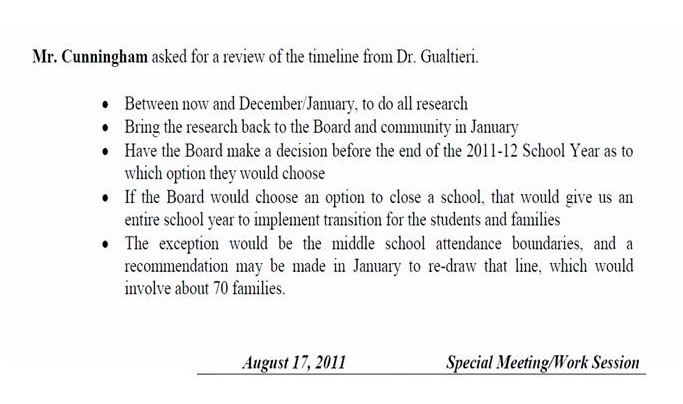
The proposed timeline for closing Peebles is an April 30, 2013 vote with closure effective for the 2013/2014 school year. In contrast, the proposed timeline for Bradford Woods was outlined as follows in the Aug 17, 2011 school board minutes:

8.17.11 Meeting minutes excerpts

So, why is the proposed timeline for Peebles an April 30th, 2013 vote with closure effective for the 2013/2014 school year?

The National Clearinghouse for Educational Facilities provides the following guidelines with respect to the decision to close a school:

  • Ideally, a decision to close a school should be made as early as possible in the school year, but no later than December.”

There are several reasons:

  • “It will permit parents and students adequate time to adjust to choose a new school or adjust to their new assignment”
  • “It will provide adequate time to plan and execute the actual closing of the building.”
  • “It will permit the financial impacts to be included in the annual school budget. There will be both additional costs and savings that need to be identified for that school.”


“When a district builds a new school or renovates an existing building, there is usually a comprehensive community involvement process used. Closing a school should also include a similar process.
Adequate time to conduct this process is important so that all relevant information can be examined and included in the deliberations. This process must have integrity above all else.”

The recommendation to close an school in the North Allegheny School District relies on two assumptions:

1. Enrollment will decline overall

2. Class size guidelines (not maximums) will be 25 students for grades K-2 and 30 students for grades 3-5

The district’s ability to close a small elementary school is contingent on a decline in student enrollment, which relies on projections prepared by the administration, as well as those contained in the Phase 2 report.
The 5-year enrollment projections prepared by the administration have consistently understated actual enrollment for the past 13 years.

Enrollment Graph 1

Consider the following:
  • In November 1999, the 2004 enrollment was forecast at 7856;
    2004 actual was 8193 (+337) [11/24/99 Post Gazette]
  • In February 2006, the 2010 enrollment was forecast at 7814;
    2010 actual was 8126 (+312) [2/2/06 Post Gazette]
  • In October 2007, the 2012/13 enrollment was forecast at 7774;
    2012 actual is 8212 (+438) [10/7/07 Post Gazette]
  • In September 2008, the 2013/14 enrollment was forecast at 7835;
    at the November 24, 2012 board meeting it was revised to 8201 (+366)
    [9/24/08 school board minutes]
  • In September 2009, the 2014/15 enrollment was forecast at 7926;
    at November 24, 2012 board meeting it was revised to 8241 (+315)
    [ 9/23/09 school board minutes]
  • In September 2010, using the trend projection formulas that the District has implemented over the past decade, it was anticipated that enrollment will show a slight increase over the next five years. Enrollment in 2010 was 8126. [9/22/10 school board minutes]

This review of the 5-year forecasts in the years 1999, 2006, 2007, 2008, and 2009 demonstrates that there is consistent evidence of the administration underestimating enrollment by an average of 353 students. Given this trend, it is reasonable to assume that 2018/2019 enrollment would be 8585 and not the projected 8101 students noted in the most recent 5-year forecast. If one-third of this increase is attributable to elementary school students, the district will exceed the target capacity of 3,720 students established by the administration.

The graph below breaks elementary enrollment out of the total enrollment forecast and compares actual to projected enrollment for 2011/12 and 2012/13.

Elementary Enrollment

The enrollment projections contained in the Phase 2 report are even lower than the forecasts prepared by the administration.
If it is acknowledged that the administration has consistently underestimated school enrollment since 1999, it is of considerable concern that the elementary enrollment forecasts set forth in the Phase 2 report are even lower than the administration’s elementary enrollment forecasts for the period 2014-2021.

For example, the Phase 2 report projected an elementary enrollment of 3278 students for 2015/2016; this was the number used in the administration’s October 24 presentation.  However, in the November 14 presentation, the administration provided its own forecast of 3401 students for 2015/2016.
Given that the school board minutes over the past 13 years reflect that the board has been concerned with the administration underestimating enrollment, it is of great concern that forecasts contained in the Phase 2 report fall even further below the administration’s projections for the years 2014-2021. If these forecasts are acceptable, it would appear that North Allegheny is preparing for a significant and unprecedented decline in its student population despite evidence of new housing starts and continued migration into the district.
————–

Letter to the Editor, Pittsburgh Tribune- Review, January17, 2013

Wrong NA fix

I am a father of four children who attend North Allegheny School District. We chose NA because of its reputation as providing a quality education.

I am a proponent of reducing costs within the district and originally supported the concept of closing an elementary school. I read the news story “Community group questions North Allegheny enrollment projections” (Dec. 6 and TribLIVE.com). Afterward, I read the Save NA Schools group‘s report mentioned in the story and realized that I made a mistake in trusting the district‘s administrators to make a sound decision.

First, closing a small elementary school (one of 12 total schools) in a district with a $127 million budget should save more like $5 million a year than $850,000 a year. Second, it is clear that at a minimum, the district should re-evaluate its data and analyze this plan again. Finally, what is really driving the deficit problem? Teachers‘ pensions.

The administration needs to address that problem with something other than cannibalizing schools, reassigning hundreds of students to different buildings and overcrowding classrooms for a pittance that will not solve the deficit problem.

Scott E. Russell

McCandless

In 2011, Bradford Woods was recommended for closure based on a projected decline in the district’s enrollment. The following statements were made by school board members in regards to the declining enrollment projections:

Source: August 17, 2011 School Board Minutes

“Mrs. Grosheider pointed out that 10 years ago, the projected enrollment for the District for last year was 7,187. In reality it was 8,126.”

“Mrs. Grosheider said it was a voluminous report and she would have appreciated an Executive Summary to help her pull the report together. She said that a 100% utilization rate at a middle school or a secondary school is more doable than at an elementary school because an elementary school tends to be neighborhood-oriented. She said if we are already at 100% capacity in an elementary school and a new family moves into the neighborhood, they would have to go to another elementary school, and that is not the way that we do business. She was informed that a number of new plans have just been approved in Franklin Park. We are getting about 80% of the school age children who live in North Allegheny; she would like a goal of getting 90% of those students and our challenge is to make sure that more of those children come to North Allegheny. She does not think that closing buildings is the best way to make that happen. Her personal goal is to ensure that the District has a great product and a great education to make it attractive to everyone in the District.”

Source: September 28, 2011 School Board Minutes

“Mr. Hubert noted that in the last five years, enrollment has increased by 2.2% overall; five years prior to that, it was down 3.4%, and for the next upcoming five years, it is projected down to 2.7%, and he challenges those numbers. He said with the economy being what it is, which is pushing people back to the public school system, and with the quality that NASD brings to the table, people migrate to North Allegheny. He does not believe that those numbers take these facts into consideration.”

“Mrs. Bishop said this past year, the live birth number was low and the downward trend started in 2000. However, she does not see a direct correlation between the birth data and class sizes. She thinks new housing plays a greater role in predicting what is going on than the live birth data.”

“The Board is very optimistic that, in light of the excellent education the District offers and the recent national recognition that both Wexford and McCandless have received for being outstanding suburbs that have excellent schools, people will continue to move into our District so that their children can enroll in our schools.”

“Mrs. Grosheider pointed out that for the six-year actual enrollments, the numbers have grown, but in the numbers that are projected, we go down. We need to be cognizant of that fact because we are looking at closing buildings and having empty seats. But our numbers are consistent overall and are actually growing. She reiterated the fact that we provide a very good education for the kids in this District and we need to sell that to the people.”

——–

Related posts:

Trib article: Community group questions North Allegheny enrollment projections

Letter to the Editor: Decline in student enrollment never materializes

SaveNASchools Community report

North Allegheny has released details of the Wednesday, January 30, 2013 hearing.

“The North Allegheny School District Board of Directors will conduct a public hearing on the question of whether or not to permanently close Peebles Elementary School, 8625 Peebles Road, Pittsburgh, PA 15237. The Hearing will be held on Wednesday, January 30, 2013, at 7:00 p.m., in the Carson Middle School Auditorium, 200 Hillvue Lane, Pittsburgh, PA 15237-5391.”

To register to speak at the hearing,  you simply need to email Rose Mary Ryan, Board Secretary, at rryan@northallegheny.org and state, “I would like to register to speak at the public hearing on January 30th.  Please confirm receipt.”  This will meet the requirement of a “formal written request.”  You will have 5 minutes to make your statement and no questions will be asked of you.

You must register before noon on Tuesday, January 29, 2013.

Please note: if you have addressed the school board in the past, none of your prior comments are included in the public record for the hearing.  To have your comments be part of the public record for closing the school, you must speak at the Public Hearing.  You do not have to come up with a new topic, a new subject, or even new words– please feel free to use notes or content from your past statements.

This is not about saving “one” school, its about saving “all seven” of the district’s elementary schools and preserving the successful elementary education model North Allegheny has used for the past several years.

Letter to the Editor, The Pittsburgh Tribune-Review, January 15, 2013

In September, North Allegheny School District parents attended school board meetings to express concern over a proposal to close Peebles Elementary. Board President Maureen Grosheider scolded residents, saying only a threat of school closure made parents pay attention.

The board was presented with 1,000-plus signatures asking for a task force to allow residents to help tackle the district‘s $10 million projected 2013-14 deficit prior to closing a school ($850,000 savings). Espe Elementary closed in 1999 — only after the district received input from a 36-member community group.

Parents delivered a 30-page analysis to the board outlining reasons against a school closure. Did Ms. Grosheider listen? During the presentation, she refused to open her copy of the report.

Now Grosheider and her hand-picked New York superintendent, Raymond Gualtieri, have a choice: Do they listen to the hundreds of parents attending meetings? Or does only their opinion matter?

In the face of community opposition, a comprehensive study and evidence of flawed data, Grosheider seems determined to close Peebles. Why? Maybe because her school in Bradford Woods is in need of renovation ($8 million to $14 million) and only a year ago was targeted for closure. It appears that a plan to save her own school by closing another is under way.

John Harrison II

McCandless

The latest installment of the district’s propaganda for closing Peebles is titled “FAQ: The Recommendation to Close Peebles Elementary School.”  Here are the 5 points we find most interesting:

  1. “NASD could close a small elementary school and still have 9 spare classrooms to work with for flexibility in the remaining six schools.”  The administration listed 11 spare classrooms in their Nov 28, 2012 presentation to the school board, but now they only have 9.  To be clear, 9 spares across 6 schools means some buildings would only have 1 spare available to manage class size.
  2. “Class size would not be affected.” 

The administration is using averages to mask what is happening on a per building basis.  The administration’s Nov 28, 2012 slides clearly illustrate that:

(1) McKnight, Ingomar, and Bradford Woods would have seen an increase in class size across multiple grade levels, and

(2) there would be 17 classes with 29+ students and minimal ability to manage class size given only one spare in some schools.

  1. “Peebles has no ‘spare classrooms’ when the facility is analyzed under the guidelines of the redistricting model, which allows for 4 sections of grades K-2.”  This highlights one of the biggest issues related to the district’s new model; the small schools that remain would be required to run 4 sections of K-2, even though they were only designed to run 3 sections.  The reason why no “spare” exists at Peebles, and only 1 or 2 “spares” exist in the remaining buildings, is because Hosack, Bradford Woods, Franklin, Ingomar, and Peebles were NOT designed to operate as 4-round schools.   
  2. “Closing Peebles Elementary School will save NASD at least $1.25M each year for the next seven years.”  The administration listed a savings of $850,000 in its Nov 28, 2012 presentation to the school board.  We wish we could explain the $400,000 change, but as we’ve already seen, the data supporting this recommendation is not consistent and continues to be a moving target.
  3. “The District does not have a tenant for the Peebles building.”  It has been confirmed that LaRoche College is the potential tenant for Peebles Elementary.  Since an official legal document is not in place, the district can technically state it “does not have a tenant.”  The administration illustrated its fondness for semantics when it recently told the Tribune Review it had “no substitute costs” because its substitutes were hired through a contractor.  Given the administration’s cost savings calculation is contingent on $1M of “Potential Lease Revenue,” it’s clear that there is indeed a tenant for Peebles.

Saving the best for last: “Mr. Thomas donated his services free of charge to complete this work.”  So, Mr. Thomas, a consultant from a construction management firm, “donated all of his services” to complete the Phase 2 report and recommended closing a school with $0 repairs instead of one with $14 million in repairs.  Nothing more needs to be said.

SaveNASchools firmly believes that NO SCHOOL in the district should be closed and its mission is to illustrate

(1) the district’s position is incorrect, and

(2) the district’s process is incorrect.

1.  SaveNASchools believes the district DOES NOT have the ability to close a school without compromising its successful elementary education model. If Peebles is closed, the detrimental impact to the remaining buildings will include;

* an increase in class size (e.g. Ingomar would‘ve seen an increase of 7 students per class in 4th grade and 4 students per class in 5th grade)

* an increase in sections (e.g. Ingomar, Franklin, Hosack, and Bradford Woods would operate as four-round instead of three-round schools)

* use of non-classrooms as classrooms (e.g. large group instruction spaces at both Ingomar and Marshall would be used as spare classrooms; the space at Marshall requires accordion walls and the space at Ingomar has no windows)

2. SaveNASchools believes the district’s process for closing a school DOES NOT adhere to a best practices model. The California Department of Education, the National Clearinghouse for Educational Facilities, and the Council of Educational Facility Planners International encourages the following best practices for considering a school closure;

* form a district advisory committee before decisions are made about a school closure that includes a cross section of community members (the school board has not addressed a petition with 1,000+ signatures requesting a community task force)

* evaluate the condition, operating costs, transportation costs, and value of each building, which includes getting appraisals (the district has not performed a cost analysis per building nor has it gotten appraisals)

* ensure the process of gathering facts is as credible, transparent, and non-political as possible (the district has two reports-the first report recommends closing a school with $14 million in repairs and the second report recommends closing a school with $0 in repairs; the second report is from a consultant that was involved in a lawsuit with the district where a judge ruled he acted in “bad faith” and cost NA taxpayers over half a million dollars)

The district’s failure to adhere to a best practices model for closing a school DOES NOT mean that a school other than Peebles should be closed. It merely highlights the district’s failure to involve taxpayers, lack of due diligence and inconsistencies regarding the process for closing a school.

TribLive Logo

Group battles Peebles Elementary closing

By Rick Wills Pittsburgh Tribune-Review

With the North Allegheny School Board poised to take public comment on whether to close Peebles Elementary School, opponents are galvanizing to prevent it. A group of parents and taxpayers calling themselves “Save NA Schools” are flooding the district‘s website, sending emails to the media, residents and school board members, and turning up at board meetings to protest any attempt to close Peebles.

They say a consultant‘s report recommending the closure ignores the fact that Bradford Woods Elementary needs $14 million of repairs, while Peebles does not.

Many group members are opposed to closing any schools.

“At the end of the day, what the board says does just not add up. Their actions with the school closings make no sense,” said Daneen Leya of McCandless, a mother of students in the district and a member of Save NA Schools.

Raymond Gualtieri, North Allegheny‘s superintendent, recommended closing Peebles to save $850,000. The district faces a $10 million deficit for the 2013-14 school year, he warned in November.

Yet a consultant‘s report says it would be more economical to close Bradford Woods. School board president Maureen Grosheider questions estimates in the report of the cost to repair Bradford Woods. The study is one of two commissioned by district. The second recommends closing Peebles.

“After the first study, the numbers for renovations just seemed excessive. The question became, ‘Are those numbers really real?‘ ” Grosheider said.

The board will hold the public hearing on Peebles on Jan. 30. A time and location have not been set. A board vote could come within 90 days of the hearing.

Ralph Pagone, one of two board members who voted last month against having a hearing, said the district is rushing the process.

“We are moving too fast. There are conflicting studies. The board did not like the first study and got a study that told them what they wanted to hear. They do not seem to be paying much attention to the public,” Pagone said.

The initial report from Architectural Innovation of Ross recommended closing Bradford Woods and keeping Peebles open. The board‘s majority favors a study by Jon Thomas of Thomas & Williamson construction consulting firm, also of Ross, which recommends closing Peebles.

James Construction Co. sued Thomas & Williamson and the school district over renovation work at North Allegheny in the late 1990s. James won damages of $524,087 from the district in Allegheny County Common Pleas Court.

“The fact that the district had a recommendation from 12 experts to close a school with $14 million in repairs and commissioned a ‘second opinion‘ from Jon Thomas is very suspect. Especially when you consider Mr. Thomas recommended closing a school with no repair costs and Judge (Timothy P.) O‘Reilly concluded he acted in ‘bad faith‘ the last time he served as a consultant for North Allegheny. This all begs the question: What was the real motivation in hiring Mr. Thomas?” said Tara Fisher, a parent of a Peebles student.

Jon Thomas could not be reached on Wednesday.

Pagone questioned the decision as well. “I am concerned with the outcome of that lawsuit. The findings were not good.”

Grosheider said Thomas has a record of success with the district.

“Mr. Thomas has done work for the district for many years, in many capacities. We have always had good results.”


Read more: http://triblive.com/neighborhoods/alleghenyneighborhoods/alleghenyneighborhoodsmore/3233983-74/board-district-peebles?printerfriendly=true#ixzz2HZI4Q2ZP

Letter to the Editor

Published 1.9.13 in the Pittsburgh Trib

I am a North Allegheny School District resident, alumnus and a parent of a daughter with special needs. I am extremely disappointed and concerned with the actions of North Allegheny‘s administration in its proposal to close Peebles Elementary School.

At the Nov. 14 school board meeting, the proposed floor plans for the remaining buildings put the hearing-impaired program into a receiving area at Hosack Elementary that currently houses cafeteria tables (aka a storage area). This was done after the administration assured the public that careful thought and consideration had been put into the placement of special needs programs.

At the Nov. 28 board meeting, Brian Miller, assistant superintendent of K-12 education, acknowledged that the district will be moving the hearing-impaired to a second-floor room at Hosack. This only came after parents mailed the floor plans to each and every board member, demanding that a change occur.

This greatly concerns me because, without parent action, the administration would have been content leaving the hearing-impaired exactly where they placed them in the storage area. This is just one example of the lack of due diligence and negligence that has taken place by the administration throughout this process.

Jamie Karlovits

McCandless